Independent guide. Some booking links earn a commission; details.
OffPathNow.cloud
Connectivity · physical SIM

Buying a SIM card at a Chinese airport: counters, passports, and the queue

The counter in arrivals still works, and it is the only way to get a real +86 number. Here is what it costs, what it requires, and when to skip it.

By OffPathNow Editorial Team · Research updated 27 October 2026 · Chengdu-based
Requirement
Passport, in person
Indicative price
¥100–300
Limit
5 SIMs / carrier
Biggest perk
+86 number

The arrivals hall at China’s major airports still has operator counters — China Mobile, China Unicom, China Telecom — selling physical SIMs to foreign passport holders. It is the only way to walk out with a real +86 number, and for month-plus stays or app-dependent trips that number is the product.

For a one-to-two-week city trip, though, an eSIM installed before you fly beats standing in a queue at 22:00. This page covers both honestly. Compare the eSIM side in our eSIM hub or the four-way Trip.com vs Airalo vs Alipay comparison.

The short answer
  • Buy at the operator hall (China Mobile / Unicom / Telecom) in arrivals, not from touts.
  • Bring your passport; registration is real-name with a photo check, in person.
  • Indicative packages run about ¥100–300; airport convenience carries a premium over city halls.
  • Want Google and WhatsApp without a VPN? A physical SIM gives mainland internet — pair it with a roaming eSIM on your second line.
How this guide was built: Counter locations, real-name registration and the five-SIM-per-carrier rule from carrier service-hall guidance and municipal government guides; price bands are indicative ranges from traveller reports, not quotes (checked 4 November 2026). Confirm packages at the counter.
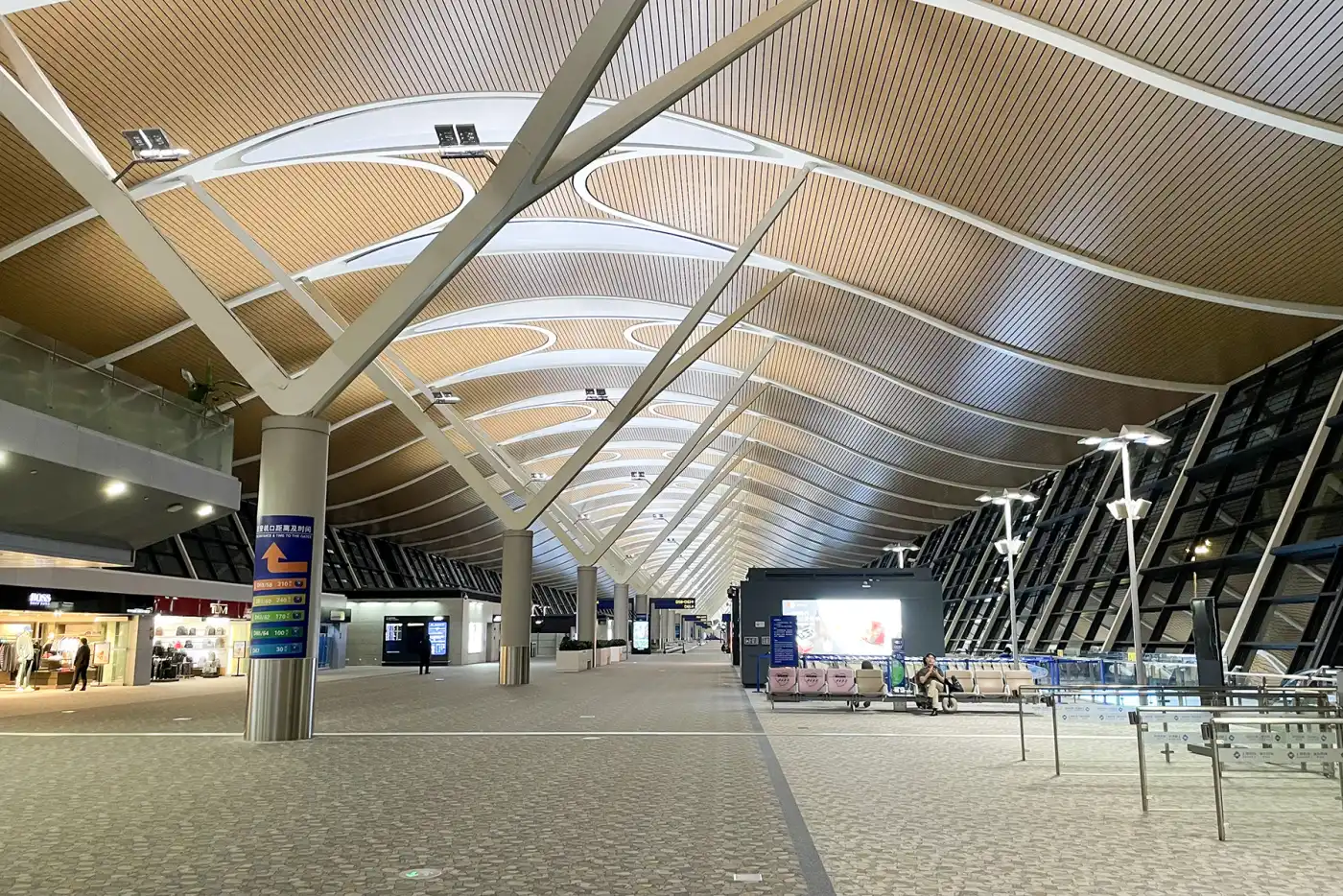
The interior concourse of a major Chinese airport terminal
The operator counters sit along this arrivals corridor. Photo: Windmemories, CC BY-SA 4.0, via Wikimedia Commons.

The counter, step by step

  1. Find the operator hall in the arrivals corridor — branded China Mobile / Unicom / Telecom counters sit in most major airports (Beijing, Shanghai Pudong and Hongqiao, Guangzhou, Chengdu Tianfu and Shuangliu among them). Ignore informal touts between exit and hall.
  2. Hand over your passport. Real-name registration with a photo check happens at the counter; nobody can register a SIM on your behalf.
  3. Choose a package, not a promise. Ask explicitly: how much data, what speed cap, hotspot allowed, validity, and whether it includes calls. Tourist data packages exist alongside resident-style plans.
  4. Pay, install, test before leaving the counter: one web page and one SMS to your hotel. Staff will slot the SIM and configure the phone for you — this is the best service moment of the whole transaction.
  5. Keep the receipt and the PIN/PUK sheet. Top-ups happen at the carrier app with a Chinese card or via counters later.

What the physical SIM wins

  • A real +86 number: SMS codes for apps that gate on Chinese numbers, delivery riders who call, reservations.
  • Domestic pricing for long stays — month two gets cheaper than any travel eSIM.
  • Works in any unlocked phone, including mainland-China iPhones that reject travel eSIMs.

What it costs you

  • Mainland internet only: Google, WhatsApp, Instagram are blocked on it. VPNs on Chinese mobile networks are unreliable.
  • The queue, at the hour you are most tired.
  • Registration friction if your passport data page has seen better days.

The setup long-stay visitors settle on

Local SIM in slot one for calls, Chinese apps and cheap data; a roaming-style eSIM on the second line for Google, WhatsApp and Instagram. The eSIM routes outside the mainland so blocked apps just work; the SIM gives you the number. Both install before the trip, and the airport counter becomes optional rather than urgent. Details: the four-way comparison.

Three things that go wrong at the counter

FAQ

Which Chinese airports have operator counters?

The major international gateways do: Beijing Capital and Daxing, Shanghai Pudong and Hongqiao, Guangzhou, Chengdu Tianfu and Shuangliu among them. Smaller airports may only have third-party resellers — if a real +86 number matters, buy at a big hub or a carrier service hall in the city.

How much does an airport SIM cost?

Indicative packages run about RMB 100-300 depending on data volume and validity, and airport convenience carries a premium over the same product in a city service hall. Treat any figure as a range until the counter quotes it.

Can I get a Chinese number on an eSIM instead?

Some China eSIM products bundle a Hong Kong number for calls and SMS, which is not a +86 number but does receive calls. A genuine +86 number currently requires a physical SIM registered in person with your passport.

Is the airport the cheapest place to buy?

No. City carrier service halls sell the same products with less tourist markup, and staff there handle more foreign registrations per day. The airport’s case is convenience, not price.

Research notes & sources

No operator paid for inclusion. Some booking links earn a commission at no extra cost to the reader. Details change — confirm with the official source before you travel.

Two lines, zero queues

Install before you fly

If a +86 number is not essential to your trip, the eSIM route needs no counter, no queue and no airport premium. Install at home and land running.

Some links are booking links. See our disclosure.

The OffPathNow network

OffPathNow.cloud is the independent China travel guide: routes, tickets, payments, eSIM and city research. Custom private China trips are planned by our sister agency OffPathNow.com.

Plan a custom China trip →